
Guillaume Delmarre
Apr 10, 2026
5 min read
Most People Rehearse Their Speech the Wrong Way (Silent Practice Is the Problem)
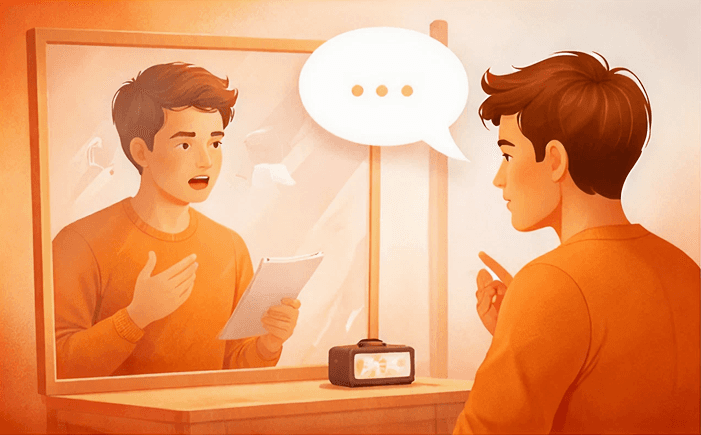
Most people think they’ve rehearsed a speech because they’ve read it a few times. The words feel familiar, the structure makes sense, and the whole thing seems to flow.
Then they try to say it out loud, and something feels off. The pacing is uneven, sentences feel longer than expected, and the delivery sounds flatter than it did in their head.
This isn’t a delivery issue. It’s a rehearsal issue. More specifically, it comes from relying on silent rehearsal, which creates a version of the speech that doesn’t match how speaking actually works.
Silent rehearsal creates a version of your speech that doesn’t exist
When you read silently, your brain optimizes for recognition, not delivery. It moves quickly through familiar phrases, compresses pauses, and removes the need to breathe. Everything feels efficient because, in a way, it is.
The problem is that none of these shortcuts exist when you speak. Once you start talking, you have to manage breath, pacing, emphasis, and timing all at once. Sentences that looked perfectly reasonable on the page suddenly feel too dense, and transitions that felt obvious become harder to carry.
That’s where the disconnect comes from. You’re not struggling to perform the speech—you’re discovering that you practiced something different from what you’re now trying to do.
What real rehearsal looks like
If there’s one change that makes the biggest difference, it’s this: rehearse out loud from the start, not just at the end.
If you’re using a teleprompter while rehearsing, this is where tools like Unscripted can help, because they’re designed to follow your natural delivery, not force you into a fixed pace from the start.
Speaking forces your script to meet reality. It reveals where the pacing breaks down, where phrasing becomes awkward, and where the structure needs adjustment. It also naturally aligns your breathing and rhythm with the content, which silent reading simply cannot do.
From there, a few practical adjustments help turn rehearsal into something that actually improves delivery.
Let your voice dictate the pace
Most people set a pace they can read comfortably, then try to match it when speaking. That usually leads to rushing. A better approach is to start slower than feels necessary and adjust from there. If the pace feels slightly slow, it’s often closer to your natural speaking rhythm.
In practice, this is much easier when your prompter lets you adjust speed dynamically or adapts to your speech, which is exactly the kind of behavior Unscripted is built around.Rewrite anything that doesn’t work out loud
Scripts are often written to look clean on screen, not to be spoken. When you rehearse aloud, you’ll notice where sentences become too long or lose clarity. Those moments are signals to simplify, shorten, or break ideas apart. Spoken language tends to be less polished but more natural.
Include small disruptions in your practice
Real delivery is never perfectly linear. You’ll glance away, think ahead, or slightly rephrase a sentence. If your rehearsal only works when you follow the script perfectly, it won’t hold up in practice. It helps to deliberately look away and come back, so you get used to finding your place again.
Where things often go wrong
A common pattern is trying to memorize the speech while also relying on the teleprompter. On the surface, this feels like a safe approach—having both memory and text as backup.
In practice, it splits your attention. Part of your focus goes toward recalling what comes next, while another part tracks the script. That division makes delivery feel less natural, because you’re not fully committed to either approach.
A teleprompter is most effective when it reduces effort, not when it adds another layer of control you’re trying to manage.
Using a teleprompter without letting it control you
The role of a teleprompter is to support your delivery, not dictate it. That means the pace should come from how you speak, with the text adapting to you rather than the opposite.
This is where features like Smart Pause in Unscripted can make a practical difference. When the scrolling stops as soon as you stop speaking, you’re not forced to keep moving just to stay aligned with the text. You can pause, think, or rephrase without losing your place. Instead of trying to keep up with the script, the script stays aligned with you, which removes a surprising amount of pressure during delivery.
That shift seems small, but it changes how you relate to the script. Instead of trying to follow it precisely, you start using it as a reference that stays in sync with your delivery.
A simple way to test your rehearsal
After running through your speech, it helps to check for a few concrete signals:
Did you run out of breath in any sentence?
Did your pace speed up without you intending to?
Did you lose your place when you looked away?
If those things happen, it’s useful feedback. They point to where the script or pacing needs adjustment, and they indicate that you’re rehearsing under realistic conditions.
Final thought
Silent rehearsal feels productive because it’s easy to go through a script quickly and without friction. But that ease comes from removing the very constraints that define real delivery.
Rehearsing out loud introduces those constraints back into the process. It slows things down, exposes issues earlier, and makes the final delivery feel more natural as a result.
In the end, the version of the speech that matters is the one you can actually say—not the one that only works in your head. Tools like Unscripted are useful in that process, but only if the rehearsal itself reflects how you actually speak.
FAQs
Can I try Unscripted for free?
Will I get future updates?